
Posted by C.J. Easter in Sports performance on October 6th, 2014
In the PSTI athlete development model, there are 4 stages to speed development:
1) Movement, 2) Strength, 3) Power, 4) Speed
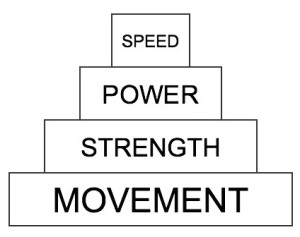
If you missed the analysis on “Stage 1: Movement”, check it out here.
Stage 2: Strength
After a solid base of movement is developed, the next stage of the PSTI athlete development model is to progressively overload these movements to build strength. An athlete’s strength determines the amount of force that they can create, so strength to body weight ratio has a high correlation to their speed. And probably more importantly, strength also determines the amount of force that an athlete can safely absorb, so strength is a huge factor in injury prevention.
None of the stages of this model are mutually exclusive. Proper movement mechanics and strength should be developed simultaneously because many movement issues come down to lacking strength through the full range of motion.
There are 3 planes of movement/strength that we develop in the PSTI model:
1) Sagittal planar movements
These are mainly your up and down and straight ahead movements. Progressively overloading movements such as squats, deadlifts, and lunges develops strength in this plane. Strength in this plane is commonly reflected on the playing field in an athlete’s vertical jumping ability or straight line sprinting.
2) Frontal planar movements
These are mainly your side to side movements. Progressively overloading movements such as lateral lunges develops strength in this plane. Strength in this plane is commonly reflected on the playing field in an athlete’s ability to change direction.
3) Transverse planar movements
These are mainly your rotational movements. Progressively overloading movements such as medicine ball throws develops strength in this plane. Strength in this plane is commonly reflected on the playing field in an athlete’s ability to throw or swing an object.
There are also 3 phases of strength that are important to develop:
1) Concentric strength
Concentric strength refers to the force exerted by a muscle as it shortens. Concentric strength largely determines an athlete’s ability to create force or speed up, so it is a major factor in skills that require rapid force production such as sprinting, jumping, or swinging/throwing.
2) Eccentric strength
Eccentric strength refers to the force exerted by a muscle as it lengthens. Eccentric strength largely determines an athlete’s ability to absorb force or slow down, so it is a major factor in deceleration, change of direction, and injury prevention.
3) Isometric strength
Isometric strength refers to the force exerted by a muscle to maintain a certain length against resistance. Isometric strength largely determines an athlete’s ability to maintain a position, so it is a major factor in contact sports in which an athlete must maintain leverage against an opponent leaning in or pushing into them.
If you are looking for a proven development model for your athlete to get faster and stronger, check out our 6-Week Complete Athlete Development Program today:
https://fittraccoaching.com//6-week-complete-athlete-development
PS- Stay tuned for part 3 of the “4 Stages of Speed Development”… (coming soon)
PPS- If you learned something from this post, I would consider it a personal favor if you used the buttons to the left to share it on social media.
Posted by C.J. Easter in Body transformation, Sports performance on October 3rd, 2014
Special Guest Post by Dr. Mike Roussell, PHD, a nutritional consultant and author known for transforming complex nutritional concepts into practical nutritional habits that his clients can use to ensure permanent weight loss and long lasting health.
The 30 Power Foods should be the center pieces of your diet. They are loaded with vitamins, minerals, essential fatty acids, essential amino acids, fiber, and phytochemicals (the things that scientists know are good for you but don’t know exactly why yet).
The Power Foods are separated into five groups: Starches (faster acting carbohydrates), Fruits & Vegetables (and other slow carbohydrates), Proteins, Fats, and the Power Food Add-Ons (these don’t fit into any of the previous categories and are commonly added to a Power Food meal).
Fruits & Vegetables
Apples
Blueberries
Broccoli
Onions
Oranges
Pumpkin
Raspberries
Spinach
Tomatoes
Beans
Starches & Grains
Quinoa
Oats
Yams
Fats
Avocado
Extra virgin olive oil
Flaxseed/flaxseed oil
Walnuts
Pistachios
Proteins
Lean poultry
Salmon
Lean red meat
Omega-3 eggs
Cottage cheese (with live cultures)
Milk protein powder
Power Food Add-Ons
Green tea
Cinnamon
Garlic
Hot peppers
Cacao (dark chocolate)
Chia seeds
Thanks for the info Dr. Mike.
-Coach C.J.
PS- If you need some help planning your nutrition to include these power foods and you’re looking for a program that focuses on both training and nutrition to develop a long-term healthy habits, our 6-Week Slim Down Program is a great opportunity to get the coaching and guidance that you need.
PPS- I would consider it a personal favor if you used the button to the left to share this article with your friends on social media.

Posted by C.J. Easter in Sports performance on October 2nd, 2014
The #1 request that we receive from parents on nearly a daily basis is…
“How can my kid get faster?”
You see, speed is a game changer across nearly every sport.
A lot of people think that speed is a genetic thing. And while all athletes have a genetic ceiling, very few are operating at a level even close to that limit.
Speed is a skill. And like any athletic skill, it can be improved with the proper developmental process.
In the PSTI athlete development model, there are 4 stages to speed development:
1) Movement, 2) Strength, 3) Power, 4) Speed

Stage 1: Movement
Movement is the foundation of speed development. The purpose of movement training is to develop total body coordination and an understanding of the how to put the body in the proper positions to maximize leverage and force production.
Within movement development, there are 4 stages that an athlete progresses through:
1) Unconscious incompetence
This is the “they don’t know that they don’t know” stage. In this stage, an athlete cannot perform a movement and does not know that they cannot perform the movement or has not really been coached on how to perform it correctly.
2) Conscious incompetence
In this stage, athletes cannot perform a movement, but are aware of that and are making progress towards being able to perform a movement. An athlete may say “it just doesn’t feel right” to describe how they feel when attempting a movement.
3) Conscious competence
In this stage, an athlete can perform when they are focused on it in a controlled environment with minimal coaching. This stage is similar to being good at a specific drill in practice.
4) Unconscious competence
In the final stage, an athlete can perform a movement without thinking in an uncontrolled environment. At this point, the training has become a reaction. This is the ultimate goal of movement training, the transference of a movement skill to the actual game.
If your athlete would like to get faster and discover our speed development program, check out our 6-Week Complete Athlete Development Program today:
https://fittraccoaching.com//6-week-complete-athlete-development